Customer story
Website redesign and UX improvement for Euroblast Middle East
Euroblast sells industrial equipment to contractors, shipyards and plant operators who size a machine before they call. Webzenia redesigned the catalogue so a buyer can find a model by what it does, compare it against its neighbours, and download its datasheet, without any existing URL moving.

The challenge
Euroblast sells to buyers who size a machine before they pick up the phone: a contractor choosing between a diesel and an electric pressure washer, a shipyard specifying a steel blaster, a food plant looking for a pump it can wash down. The catalogue runs to 235 products across 81 categories, from Graco fluid handling and SANIFORCE food-grade pumps to Blastrac shot blasters, scarifiers, grinders and the Fussen washer range.
At that size, the site has to answer three questions on every page: what this machine is, how it compares with the ones next to it, and where the datasheet is. A product page reached from search was a dead end. It described one model and offered no route to the model with more pressure, the diesel version or the next size up.
The redesign also had to keep the search history the previous site had earned. Every URL that ranked had to keep resolving, through the rebuild and through every range change after it.
The approach
A structured catalogue, not a set of pages. Webzenia rebuilt euroblastme.com on WordPress and Bricks Builder with products as their own content type and an 81-term product-category hierarchy. Each product carries structured fields for its description, gallery, datasheet PDFs and videos, rendered through one Bricks template, so a layout change reaches all 235 product pages in a single edit.
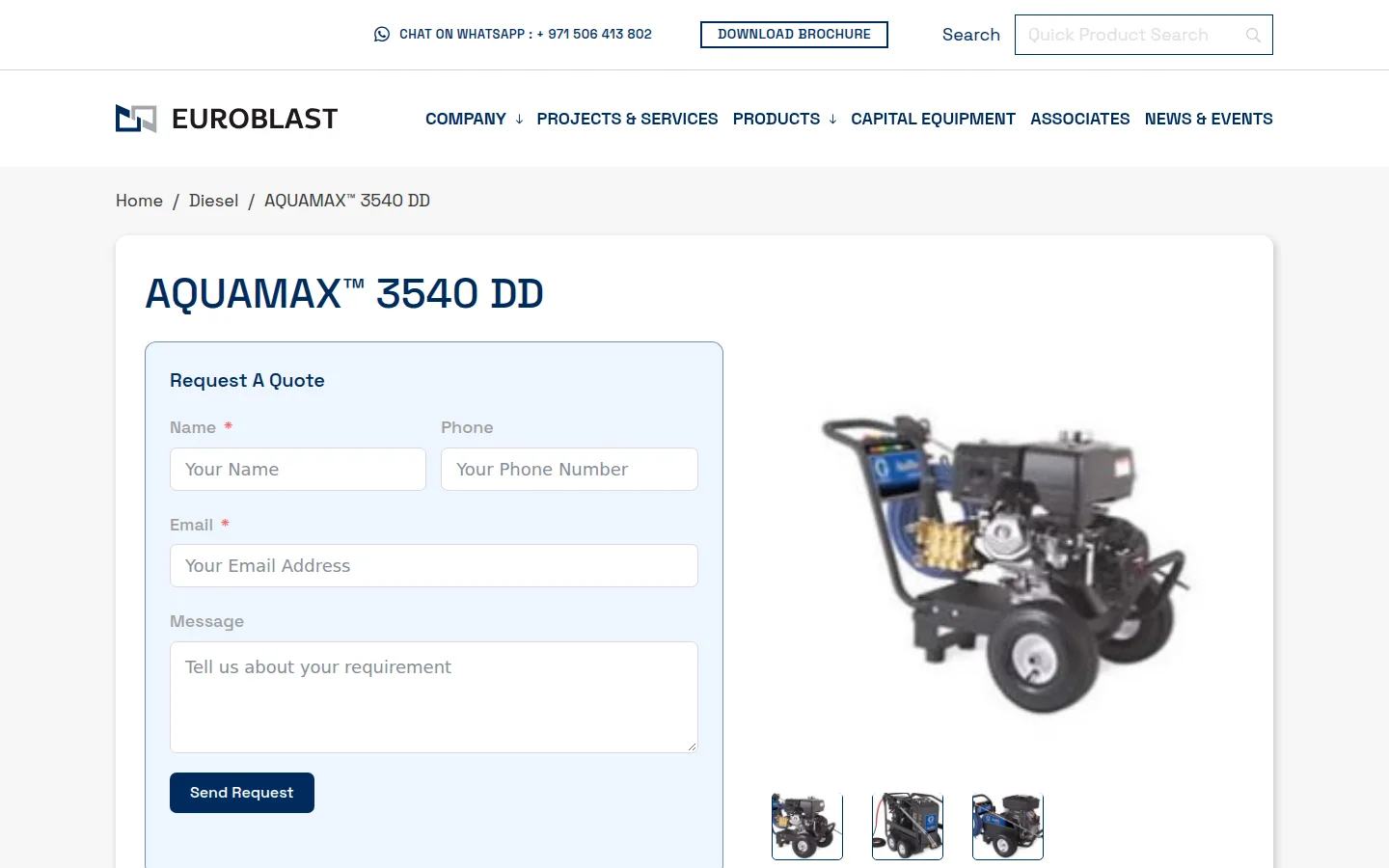
Tabs that match how a machine is evaluated. Each product page separates details, features and specifications, and files and keeps a quote request form beside the machine. In the Fussen range, specification tables are built from Euroblast’s own spec sheet with models as columns, so a buyer reads the range side by side instead of opening four pages.
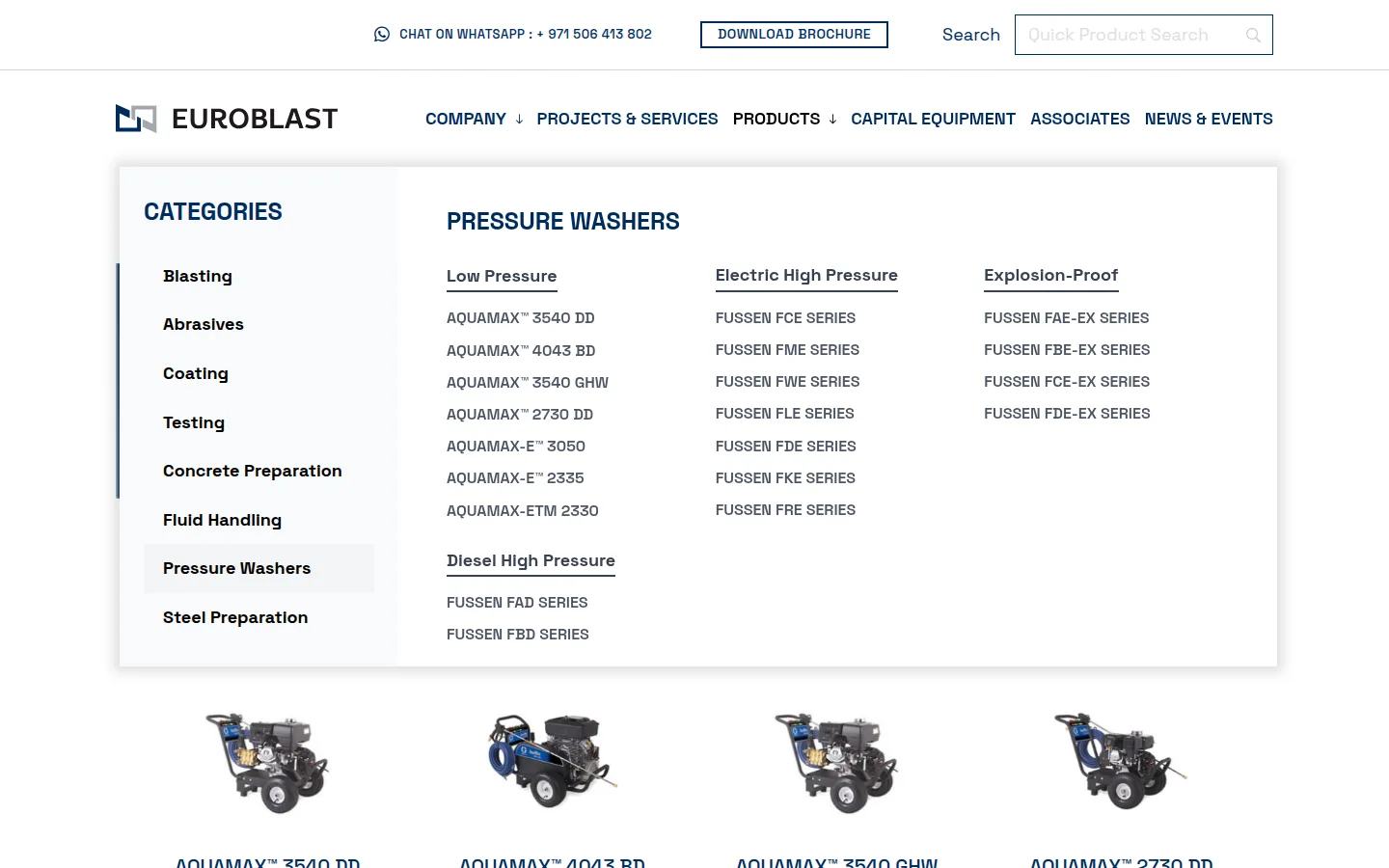
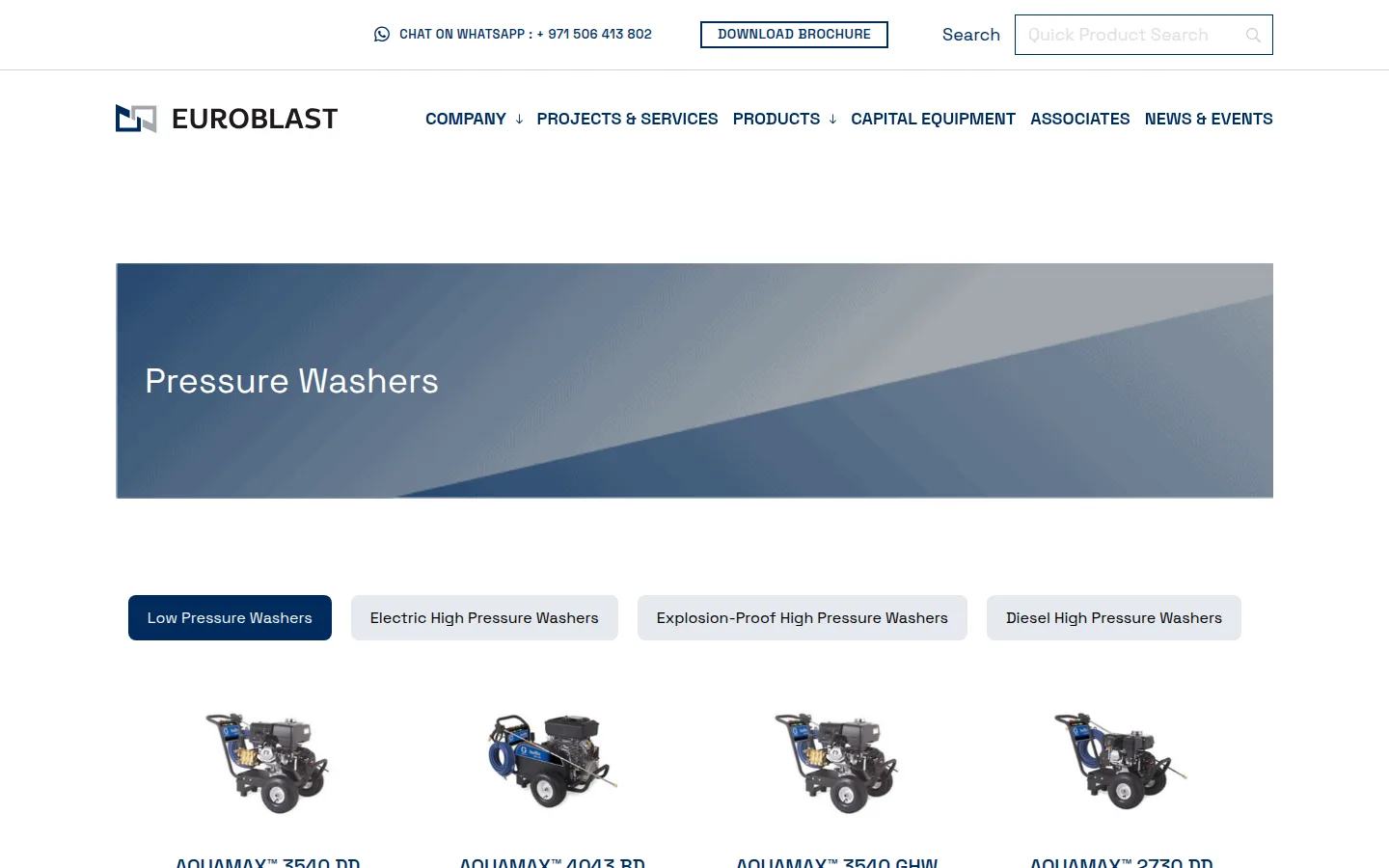
Navigation by power source. Buyers choose a washer by fuel and pressure before brand. The Fussen range was regrouped into low-pressure, electric high-pressure, explosion-proof and diesel high-pressure sections, and the mega menu was rebuilt to match on desktop and mobile. On 3 September 2026 Webzenia published 16 models from Euroblast’s spec sheet in one day: 11 new, 5 updated, each with its own description, spec table, image and datasheet.
URLs under explicit control. Permalink Manager Pro holds every product address, so WordPress never rewrites one on save. Existing URLs are frozen because they carry the previous site’s search equity, and new products follow an agreed path that encodes range, pressure band and power source. Three models Euroblast withdrew were retired with 301 redirects to their range page, and every affected URL was swept for a 200 response before and after release.
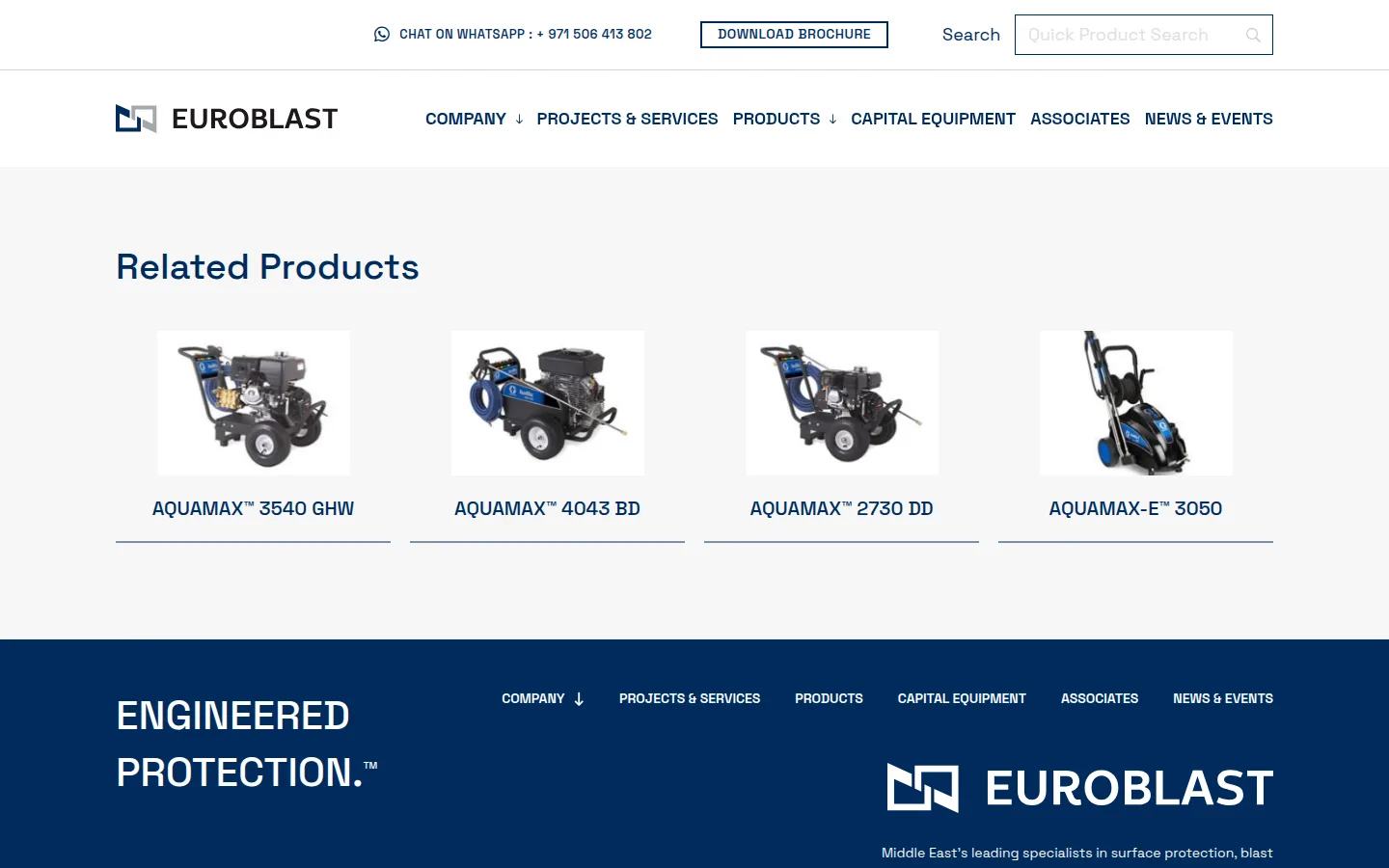
A related-products engine. Every product page now ends with four comparable machines, resolved when the page renders rather than typed in by hand. The engine works outward in tiers: the same category and series first, ordered by nearest model number; then the same series in neighbouring categories, never crossing a top-level category; then the parent categories, nearest first. Within each tier, a product with an image, a spec table, a real description and a datasheet ranks above a thin one, so the suggestion is also the best-documented machine.
The catalogue stores no brand field, so the engine infers the series from the product title and only treats a prefix as a series when at least two products share it. A title-word tier was tested and rejected: it paired a rotary drum separator with food-grade drum pumps on the word "drum". The row is four cards, not six, because 61% of products have four true category siblings and only 40% have six. A row of six would have filled itself with loose matches.
Editorial control stays with Euroblast. A relationship field on the product screen takes up to four hand-picked machines in drag order, or hides the row. The automatic picks are shown read-only beside it and are never written to the database, so a bulk edit cannot freeze a stale recommendation onto a page.
A speed layer in front of every page. Built fresh by WordPress, a page on this catalogue takes a little over a second to leave the server. FlyingPress now stores each page as finished HTML and serves that copy instead, a Redis object cache holds the database results WordPress would otherwise repeat, and pages carry a 30-day CDN cache header.
The front end was trimmed alongside it. Bricks writes its CSS to static files the browser can cache rather than inlining it into every page, product images are compressed through ShortPixel, and the restructured pressure-washer range was uploaded as WebP. Both caches are flushed after every release, so the speed never costs a stale specification or datasheet.
Search and contact from every page. SearchWP runs live product search in the header, next to a WhatsApp line and the brochure download, so a buyer who knows the model number never has to browse for it.
Every change ships through staging. Webzenia runs a sealed copy of the site behind a password, blocked from search engines and outgoing mail. Changes are written as repeatable scripts, verified on staging, then re-run on production after a full backup, each with its own rollback. The staging database is never pushed to production, because it would overwrite the 1,584 URL mappings and the live page-builder data.
The results
The related-products engine went live on 21 September 2026 across all 235 product pages in one release. 219 pages show four related machines and 3 show three. The remaining 13 are uncategorised products, where the row hides rather than padding itself with weak matches.
The recommendations follow the range the way a buyer does. The AQUAMAX 3540 DD now leads to the 3540 GHW, 4043 BD, 2730 DD and AQUAMAX-E 3050: the same series, nearest model numbers first. Placing the same series above the rest of the category improved the picks on 15 products and worsened none.
The pressure-washer restructure changed none of the 1,584 existing URLs, and all 16 new product pages returned 200 on the first sweep.
The speed layer answers about eight times faster than WordPress building the same page. Measured on the live site on 30 September 2026, with the cache bypassed and then in place, the median server response fell from 1.08 seconds to 0.13 seconds on a product page, 1.11 to 0.13 on the range page and 1.28 to 0.18 on the homepage.
The stack behind it
Selected deliverables
Your turn
Want results like these?
Tell us where you want to grow. We'll map the first 90 days and show you what's realistic for your market.
What happens next
- 1A 30-minute discovery callWe learn your goals and constraints
- 2A tailored growth planChannels, milestones, and a realistic timeline
- 3KickoffA senior team, not a junior handoff
Start the conversation