Digital Marketing
What counts as a good CTR in 2026
CTR is clicks divided by impressions. In 2026 the median Google Search campaign runs at 8.88%, a whole Google Ads account at 4.64% and a Meta ad at 1.18% on link clicks. In the UAE, low volume makes CTR swing, so judge it over at least 30 days against the account's own history.

Click-through rate (CTR) is clicks divided by impressions: 50 clicks from 1,000 impressions is a 5% CTR. In 2026 the median Google Search campaign runs at 8.9%, the median Google Ads account across all campaign types at 4.6%, and the median Meta ad at 1.2% on link clicks. A good CTR beats those, and beats the account's own last 90 days, on the same definition of a click.
Admanage.ai's recent infographic put Google Search at 12.30%, Meta at 2.30% and Snapchat swipe-ups at 1.40%, as median account figures for September and October 2026. Webzenia could not trace the data behind it, and 12.30% sits above every published search median. Its footer gives the right advice: compare like for like. The figure below does that, with each platform's definition printed under its number.
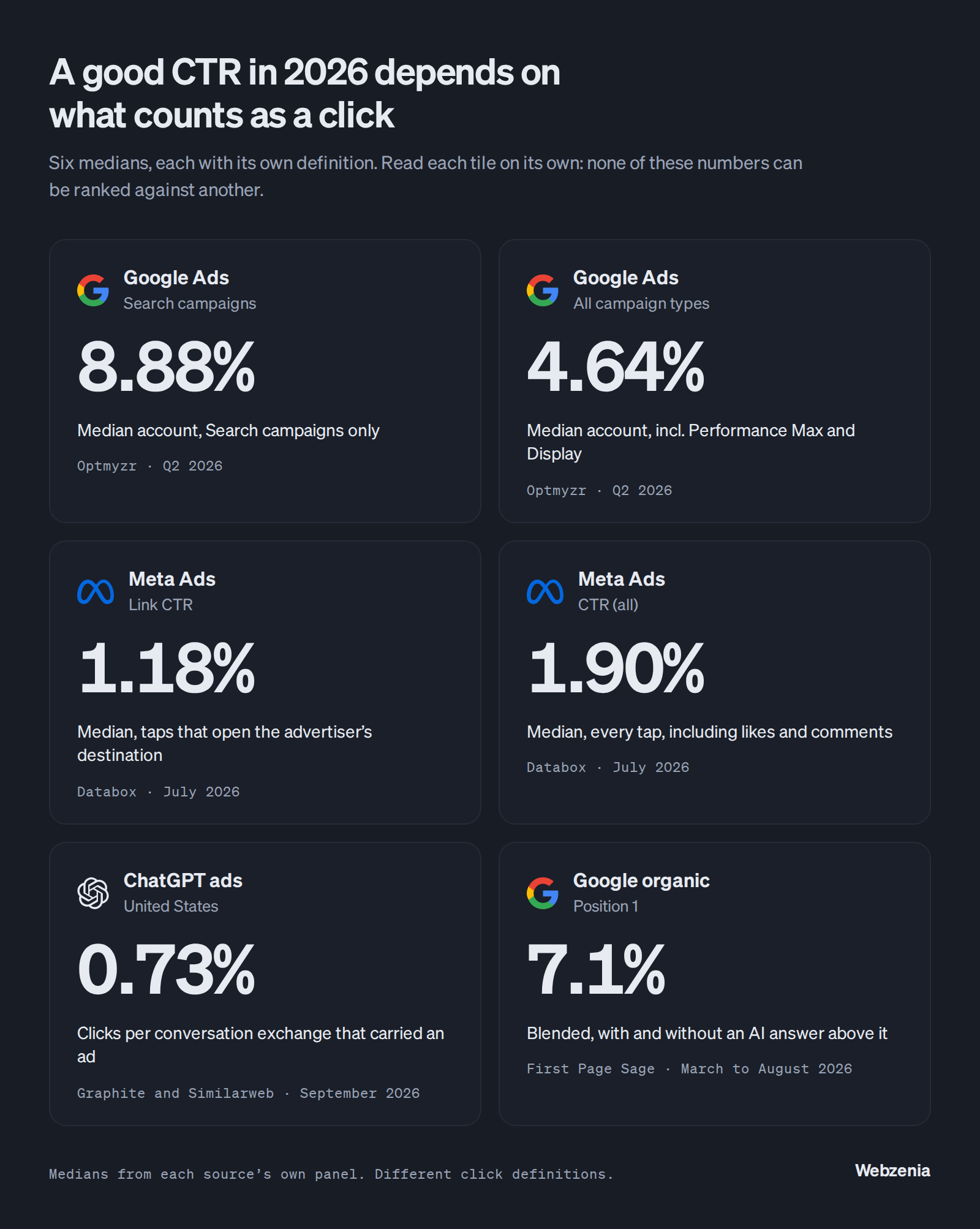
What is a good Google Ads CTR in 2026?
A good Google Ads CTR in 2026 starts at 8.88% for a Search campaign, the median account in Optmyzr's Q2 2026 benchmark. Across all campaign types the median is 4.64%, pulled down by Performance Max and Display. Judge a Search campaign against 8.88%. LocaliQ's 6.64% is an average, and it blends in Microsoft Ads.
Low search volume makes UAE CTRs volatile. On a campaign with 100 impressions a week, 2 clicks either way moves CTR by 2 points, so read a UAE CTR over at least 30 days. Brand searches distort it further: people who type a company's name already want that company, so those searches click far above generic ones. Ask for brand and non-brand CTR as two separate numbers in every Google Ads management report.
Ads cannot appear inside an AI Overview in the UAE. Google lists 12 countries where they can, and the UAE is not one; ads above and below the Overview still run. Seer Interactive, a US agency, found across 42 of its clients that paid CTR on informational searches fell from 19.7% to 6.34% between June 2024 and September 2025 when an AI Overview appeared, and from 19.1% to 13.04% when one did not. Seer says its 1.1 million paid impressions show the direction of the change, not its exact size.
What is a good Meta ads CTR?
A typical Meta ads CTR is 1.18% on link clicks and 1.90% on all clicks, the medians in Databox's benchmark of more than 2,800 companies (July 2026). Meta reports both for the same ad, plus outbound CTR, so one campaign can show three different numbers. AdKit's October 2026 median for outbound CTR is 1.02%, from a different dataset, so the three medians are not a like-for-like ladder.
| Metric | What it counts | Formula | Use it for |
|---|---|---|---|
| CTR (all) | Every click on the ad: link clicks, likes, comments, shares, clicks to the Page or profile, and photo or video expands | Clicks (all) divided by impressions | How much attention the creative gets |
| Link CTR | Clicks on links to destinations on or off Meta, including lead forms | Link clicks divided by impressions | Click-to-WhatsApp ads and instant-form lead ads |
| Outbound CTR | Clicks that leave Meta for a website, an app store or an app | Outbound clicks divided by impressions | Ads that send traffic to a website |
For lead campaigns that run to WhatsApp or an instant form, judge link CTR. Neither leaves Meta, so outbound CTR under-counts them, and all-click CTR rewards an ad people react to without acting on.
Meta also changed what counts as a click for conversion attribution this year. From late March 2026, Meta credits a lead or sale to an ad click only when the click was on the link; a like, save or share before the purchase is now reported separately, as engage-through. Billing did not change. A conversion report that dropped in April may be showing the reclassification rather than a weaker campaign, so compare Meta ads results from April onwards with each other, and leave March out of the trend.
What is outbound CTR on Meta ads?
Outbound CTR is the share of a Meta ad's impressions that led to a click out of Meta's apps, to a website, an app store or an app. Meta's Business Help Centre defines it as "outbound clicks divided by impressions": 20 outbound clicks from 2,000 impressions is an outbound CTR of 1%. A typical figure is 1.02%, AdKit's October 2026 median across more than 1,900 advertisers in all countries.
Meta counts as outbound only clicks on links "that lead to destinations outside Meta technologies": a website, an app's store page or a screen inside the advertiser's own app. Link clicks are wider. Meta's list includes clicks into "lead forms, Canvas and collection", so opening an instant form is a link click but not an outbound click, and so is opening a WhatsApp or Messenger chat, which also stays inside Meta.
Choose the CTR that matches where the ad sends people. For an ad that sends traffic to a website or a Shopify store, outbound CTR is the closest measure of visits. For a click-to-WhatsApp or instant-form lead ad, which is common in the UAE, outbound CTR will sit close to zero even when the campaign works, so judge it on link CTR and cost per lead in your Meta ads reports.
Two gaps between the numbers are worth checking:
- Outbound CTR far below link CTR on a website ad: people are opening something that keeps them inside Meta, such as an Instant Experience or a lead form, before they reach the site.
- Outbound clicks far above visits in the website's analytics: visitors leave before the page loads, or the tracking code is missing. Test the landing page on a phone over mobile data.
AdKit's figures come from advertisers using its tool: a quarter of those advertisers sit below 0.14% and a quarter above 2.06%, and the monthly median ran from 0.83% to 1.02% between November 2025 and October 2026. No published benchmark gives outbound CTR for the UAE alone, and low UAE volumes make the figure swing, so compare your account's outbound CTR with its own last 90 days. Meta's March 2026 change altered which clicks earn credit for a conversion, not how outbound CTR is counted.
Snapchat and TikTok CTRs in the UAE
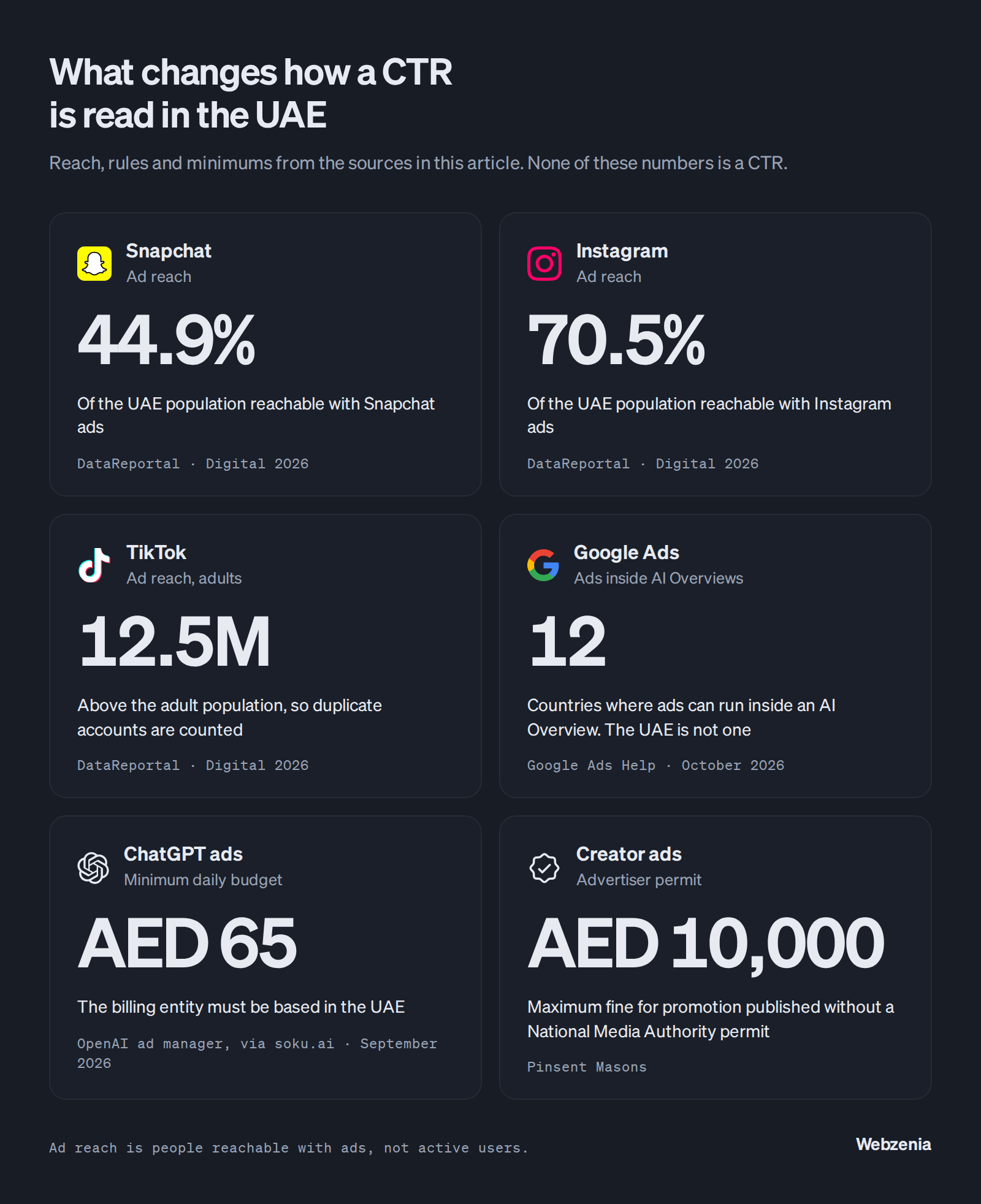
Snapchat's ads reach 5.13 million people in the UAE, 44.9% of the population, on DataReportal's Digital 2026 figures, against 70.5% for Instagram. That makes Snapchat a channel to plan from the start, beside Instagram. None of the Snapchat CTR benchmarks Webzenia found states its method. Snapchat reports swipe-ups, and sources disagree on whether that counts every swipe or only those that loaded the page. Measure Snapchat on visits recorded in the website's own analytics, which count only the swipes that arrived.
TikTok's ad reach in the UAE is 12.5 million adults on the same report, more than the adult population, which DataReportal itself flags as a sign of duplicate accounts. Vendor aggregations put TikTok's in-feed CTR near 1%, and Spark Ads, which promote a creator's own post, near 2.4%. Judge TikTok, like Snapchat, on visits recorded in the website's own analytics.
Creator-led ads carry a compliance step. Creators who publish promotional content in the UAE, paid or unpaid, need an advertiser permit from the National Media Authority, and the deadline to obtain one passed on 31 January 2026. A creator without one faces fines of up to AED 10,000, and brands and agencies that pay for the content must also comply.
What CTR do ChatGPT ads get?
ChatGPT ads get a CTR of 0.73% in the US and 1.91% in Brazil, counted per conversation exchange that carried an ad, in Graphite and Similarweb's report of 29 September 2026. Each market is measured from its launch to 16 September, so Brazil's figure covers about 6 weeks. The UAE has no published figure yet.
Those rates count clicks per ad-bearing exchange, not per impression, so they cannot sit on the same scale as Google's 8.88%. OpenAI's own help centre says ChatGPT ads have no performance benchmarks across advertisers yet.
OpenAI's advertiser tools have listed the UAE since mid-September 2026. The minimum daily budget is AED 65, and the billing entity must be based in the UAE. Run a first campaign close to that minimum, about AED 1,800 over 4 weeks, with its own conversion tracking, and judge it on cost per lead.
What is a good organic CTR in 2026?
A page in position 1 on Google has a CTR of 22.6% when no AI answer appears above it, and 3.6% when one does. That is First Page Sage's data for March to August 2026, from 1,184 domains and 3.67 billion impressions, weighted to US search volume. Blended across both, position 1 runs at 7.1%. No equivalent study is published for UAE search, so read these as the shape of the curve, not a target.
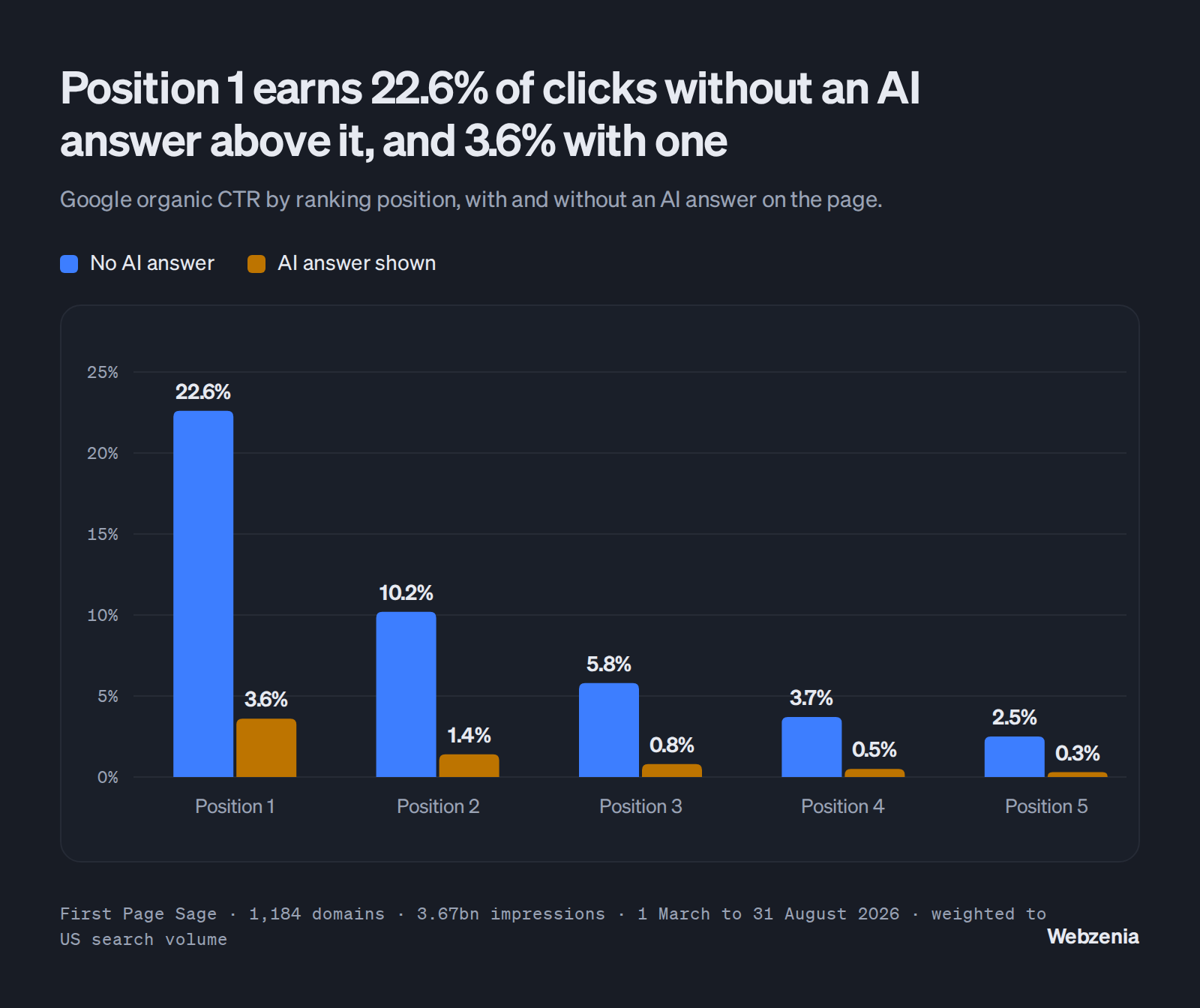
The 3.6% figure is the one to plan informational pages around. Google's AI Mode has answered English searches in the UAE since late August 2025, which puts more of those searches behind an AI answer.
Search Console's CTR between May 2025 and April 2026 is distorted twice. Google says a logging error stopped Search Console reporting impressions accurately from 13 May 2025 to 27 April 2026, and impressions fell once it was fixed, so CTR across that window reads lower than it was. In mid-September 2025, Google also stopped honouring the setting that loaded 100 results on one page, which rank-tracking tools relied on. That removed impressions from results on pages two to ten that no person saw, and pushed CTR up.
A year-on-year organic CTR comparison across those dates measures Google's reporting changes rather than the site, so compare clicks instead. First Page Sage's own window overlaps the last eight weeks of the logging error.
Organic CTR by ranking position
On Google in 2026, the average organic CTR runs from 7.1% at position 1 to 0.2% at position 10, blended across searches with and without an AI answer. Without an AI answer, position 1 earns 22.6% and position 10 earns 0.5%; with one, position 1 earns 3.6% and position 10 earns 0.1%.
| Position | No AI answer | AI answer present | Blended CTR |
|---|---|---|---|
| 1 | 22.6% | 3.6% | 7.1% |
| 2 | 10.2% | 1.4% | 3.0% |
| 3 | 5.8% | 0.8% | 1.7% |
| 4 | 3.7% | 0.5% | 1.1% |
| 5 | 2.5% | 0.3% | 0.7% |
| 6 | 1.8% | 0.3% | 0.6% |
| 7 | 1.3% | 0.2% | 0.4% |
| 8 | 0.9% | 0.2% | 0.3% |
| 9 | 0.7% | 0.1% | 0.2% |
| 10 | 0.5% | 0.1% | 0.2% |
First Page Sage, a US search agency, built this table from the Search Console data of 1,184 domains. It covers 3.67 billion impressions between 1 March and 31 August 2026, mobile and desktop combined, weighted to US search volume. Its "AI answer" is either an AI Overview or a full AI Mode response. Use the blended column for traffic forecasts, and the two split columns to see how much an AI answer on the site's own searches would cut that forecast. First Page Sage says the no-AI-answer column now mostly represents "people returning to sites they already know", so 22.6% reflects brand searches more than new customers.
Position 1 earns more than positions 2 and 3 combined in all three columns. Moving from position 3 to position 1 more than quadruples blended CTR, from 1.7% to 7.1%. In the blended column, positions 8, 9 and 10 sit within 0.1 percentage points of one another.
Published figures for position 1 range from 1.6% (Ahrefs, desktop, keywords with an AI Overview) to 39.8%, because each study measures a different set of searches:
- Query mix. Informational searches carry an AI answer most often: above 94% of US informational and commercial-research searches, on First Page Sage's count. Seer Interactive's 2025 study looked only at informational searches, and Ahrefs' comparison group was informational; First Page Sage mixes every intent.
- Brand searches. People who type a company's name click its result far more often. Few studies state whether they removed brand searches, and First Page Sage removes navigational searches only from its share-of-discovery figures.
- Device. Ahrefs measures desktop CTR only; First Page Sage combines mobile and desktop.
- Results-page features. A map pack, a row of videos, shopping results or an AI answer each take clicks away from the ordinary results.
- Date. First Page Sage counts an AI answer on 81.6% of US searches in September 2026, against 23.4% a year earlier. Even a 2025 table describes a different results page.
The 39.8% figure for position 1, still reprinted in articles dated 2026, is 2023 data. First Page Sage posted it on 23 October 2023, measured only on results pages "with no other elements on them (e.g. no maps, images, videos, or shopping results)". It kept the same table in its reports titled 2025 and 2026 until the September 2026 edition replaced it.
Webzenia found no published study of organic CTR by position for UAE search, and every study above is weighted to the US. A UAE website's most reliable benchmark is the one it builds from its own Search Console data. Because UAE search volumes are low, use every month since Google fixed the Search Console logging error, starting on 28 April 2026. Ask whoever manages the website's Search Console to build this, as follows:
- In Search Console, open the property, then Performance and Search results, and set the date range to start on 28 April 2026.
- Take out brand searches. Where Search Console offers the Non-branded query filter, which Google introduced in November 2025 for top-level properties with enough impressions, apply it. Otherwise click + Add filter, choose Query, then Custom (regex) and Doesn't match regex. Enter the brand name and its short form in English and Arabic, with common spellings in each. Put them in brackets, separated by a vertical bar: (brandname|brand name).
- Click + Add filter again, choose Country and select United Arab Emirates, so that searches from other countries do not blend in. Then add a Device filter for Mobile, and repeat for Desktop separately.
- Switch on Average CTR and Average position above the chart, open the Queries tab and export the table.
- In Google Sheets or Excel, group the queries by average position. Divide each group's total clicks by its total impressions. Never average the CTR column, because a query with 20 impressions would then count as much as one with 2,000. On a site with few impressions, wider groups (positions 1 to 3, 4 to 6 and 7 to 10) give a steadier figure than one group per position.
Compare each group with the matching rows of the blended column above. Filtered totals will be lower than the full report, because Search Console drops anonymised queries once a query filter is applied. A group well below its row usually has an AI answer, ads or a map pack above it, or a title that does not match the search. Search a few of those queries on a phone, from the emirate the customers are in, to see which.
Organic CTR has fallen most at the top since AI Overviews
On searches that show an AI Overview, organic CTR is lower at every position on page one, and lowest at the top. Ahrefs found in February 2026 that organic CTR at position 1 was 58% lower than its estimate without an Overview, and 19.4% lower at position 10. The study used desktop keywords and names no country; Ahrefs calls the result a correlation, not proof of cause.
Ahrefs compared average desktop CTR for 300,000 keywords in December 2023, before AI Overviews, and in December 2025. At position 1, keywords that now show an AI Overview fell from 7.3% to 1.6%, while informational keywords that still show none fell from 7.6% to 3.9%. The estimated loss falls further down the page: 50.8% at position 2 and 32.6% at position 5.
Pew Research Center measured the same effect from the searcher's side, in a study of 900 US adults published on 22 July 2025. In March 2025, they clicked an ordinary result in 8% of visits to a results page with an AI summary, against 15% without one. They clicked a link inside the summary in 1% of visits. Pew counts visits, not impressions at a position, so its figures do not sit on the same scale as the table above.
Organic CTR on AI Overview searches has partly recovered since late 2025. Seer Interactive's update of 24 April 2026 covers 53 brands and 5.47 million queries of informational, commercial and transactional intent. It puts organic CTR on AI Overview searches at 1.31% in December 2025 and 2.36% in February 2026, while searches without an Overview rose from 3.16% to 3.82%. The fall before that was steep. On informational queries that showed an AI Overview by September 2025, Seer's 42 clients saw organic CTR drop from 1.76% in June 2024 to 0.61% in September 2025. Queries without an Overview fell from 2.72% to 1.62% over the same months, in the study Seer published on 4 November 2025. Seer states that it cannot claim causation.
Fewer searches now end in a click of any kind. SparkToro reported on 8 June 2026 that 68.01% of US Google searches from January to April 2026 ended without a click, on Similarweb's panel. The 2024 figure was 60.45%, on a different panel from Datos, and SparkToro cautions that the two do not cover the same users or devices.
Google brought AI Overviews to the Middle East and North Africa, and to Arabic searches worldwide, on 20 May 2025. Its AI Mode has answered English searches in the UAE since late August 2025. For a UAE website, compare organic clicks month by month from May 2026 rather than year on year. Queries that lost clicks while holding their position are the ones an AI answer now satisfies. On First Page Sage's US-weighted data, the first source cited in an AI answer earns 5.2% CTR, against 3.6% for position 1 on results pages with an AI answer. Writing pages that earn that citation is now part of SEO work.
How do you know if your CTR is good?
A CTR is good when it beats the median for the same click definition, holds up once brand searches are taken out, improves on the account's own last 90 days, and arrives with a falling cost per lead. Check them in that order, before any industry table:
- The same definition. Link CTR against link CTR, Search against Search. A Search campaign never shares a row with Performance Max.
- Brand and non-brand, split. A blended account CTR hides the number that matters.
- The account's own last 90 days. A CTR that moves against its own history is informative; one placed next to an industry median rarely is.
- Cost per lead. A CTR that rises while cost per lead rises has found more curious people, not more buyers. Usually the ad promises something the page does not deliver.
CTR says a lot about the creative: whether the image, the headline and the offer earn a click from the people who see them. It is still only one perspective on a good ad. The audience it reaches, the landing page, how often the same person sees it and what each lead is worth all decide whether an ad pays. Cost per lead and closed sales settle it, which is what performance marketing reporting should track, from the account's own analytics.
Frequently asked questions

Prasanna founded Webzenia, which has worked with Gulf clients since 2018, and advises on search and paid media. He watches more cricket than he will admit to, a sport nobody has ever explained with a batting average alone, and he takes the same view of a platform's published average.
LinkedInRelated reading

Google Ads can target within 1km of a business
Google Ads can target within 1km of a business, tighter than most accounts ever set it. What an account Webzenia runs found when it did, and why low search volume changes the read.

How to create a company website in the UAE, step by step
The steps to create a company website in the UAE: .ae or .com, the platform, the pages, Arabic, running costs, data protection consent and a 12-week build.
Get your ad account read against its own numbers
A Webzenia strategist splits brand from non-brand, checks each CTR against its own definition and history, and reports what it costs you per lead.
Tell us what you need.